
When Does GERD Require Surgery Instead of Medication?
Introduction
If you’ve been popping antacids for months and still waking up at 2 a.m. with that familiar burning feeling in your chest, you’re not alone, and you’re probably wondering if medication is ever going to be enough. For most people with GERD, it is. But for a smaller group, it isn’t, and that’s when the conversation around GERD Surgery in Mumbai usually comes up. Here’s how to know which side of that line you might be on.
What Exactly Is GERD?
GERD stands for Gastroesophageal Reflux Disease, in simple words, it’s what happens when the valve between your stomach and food pipe stops closing properly. Stomach acid then flows backward into the food pipe, causing that burning sensation we call heartburn, along with a sour taste, chest discomfort, or a nagging cough that won’t quit.
Occasional acid reflux after a heavy meal is normal. GERD is when this happens often enough, and strongly enough, to disrupt your daily life.
Why Medication Is Usually the First Step
For most people, GERD responds well to a fairly standard approach:
- Acid-reducing medicines – such as PPIs (proton pump inhibitors) or H2 blockers, which cut down how much acid your stomach produces.
- Diet changes – cutting back on spicy, oily, or acidic foods, along with caffeine and late-night meals.
- Lifestyle tweaks – smaller meals, staying upright after eating, and losing excess weight if that’s a factor.
These steps work for a large majority of patients, which is exactly why surgery is never the first suggestion a doctor makes.
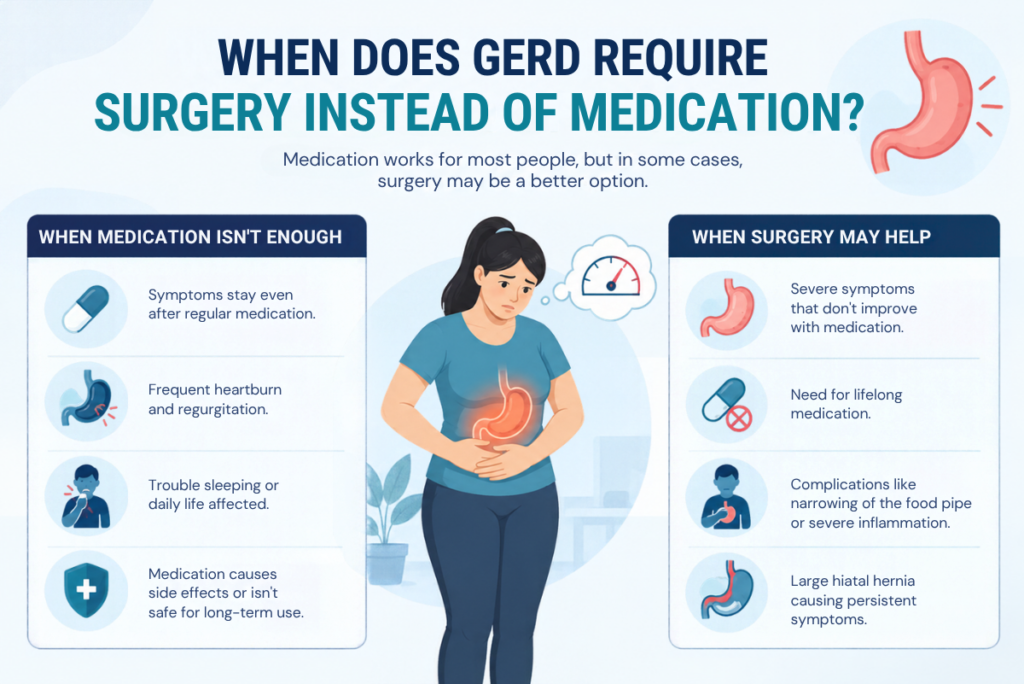
When Medication Isn't Enough
Surgery usually enters the conversation when a few specific things happen:
- Symptoms persist despite proper medication. If you’re taking your medicines correctly and still dealing with daily reflux, that’s a clear signal something more may be needed.
- You’ve become dependent on long-term medication. Some people don’t want to be on acid-suppressing drugs indefinitely, especially for years at a stretch.
- Complications start showing up. Conditions like Barrett’s oesophagus (changes in the food pipe lining caused by long-term acid exposure) or a large hiatal hernia often tip the scale toward surgery.
- Reflux is affecting your breathing or sleep. Acid reaching the throat or lungs can cause chronic cough, hoarseness, or even aspiration, and medication alone doesn’t always fix the underlying valve problem.
If any of these sound familiar, it’s worth having a focused conversation with a specialist rather than simply increasing your dosage.
What Does GERD Surgery Actually Involve?
The most common procedure is called fundoplication. In simple terms, the surgeon wraps the upper part of the stomach around the lower end of the food pipe, which tightens and strengthens the weakened valve so acid stops flowing backward.
The reassuring part is that this is almost always done laparoscopically today — through a few small incisions rather than open surgery. We are equipped to perform these minimally invasive procedures, which generally means less pain, a shorter hospital stay, and a quicker return to normal activity compared to older surgical methods.
Is Surgery the Right Call for You?
This isn’t a decision to rush into. Some useful questions to bring to your consultation:
- Have all reasonable medication options actually been tried?
- Are my symptoms caused by GERD, or could something else be mimicking it?
- What would my recovery timeline realistically look like?
- What are the risks if I choose to keep managing this with medication instead?
A proper diagnostic workup — usually involving an endoscopy and sometimes a pH test to measure acid levels — helps confirm whether surgery will actually solve the problem, rather than just managing symptoms.
What Recovery Looks Like
Most people are back to light activity within a week or two after laparoscopic surgery, with full recovery typically settling in over four to six weeks. In the early days, a soft or liquid diet is usually recommended while the stomach and food pipe heal. Long-term, many patients find they can finally come off their daily acid medication altogether, which is often the biggest relief of all.
The Bottom Line
GERD surgery isn’t meant for everyone, and that’s exactly why it’s not the default option. But when medication stops working, or when complications start building up quietly in the background, it becomes a genuinely worthwhile path to explore. If you’re considering GERD Surgery in Mumbai, a detailed evaluation with a specialist like Dr Hrishikesh Salgaonkar can help you understand exactly where you stand and what your options realistically look like.