
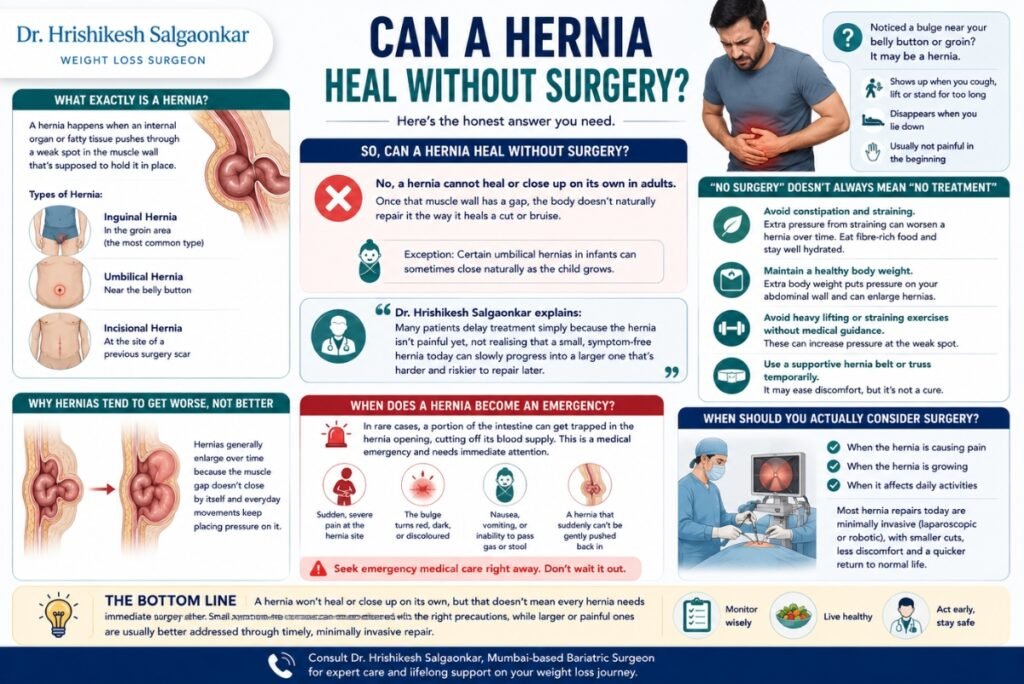
Can a Hernia Heal Without Surgery?
Introduction
Noticed a strange bulge near your belly button or groin that wasn’t there before? Maybe it shows up when you cough, lift something heavy, or stand for too long, and disappears when you lie down.
That’s usually a hernia, and the first question almost everyone asks is the same: “Can this just heal on its own if I rest enough or avoid heavy lifting?”
Let’s answer that honestly, without the internet-forum guesswork.
What Exactly Is a Hernia?
In simple terms, a hernia happens when an internal part of the body, usually the intestine or fatty tissue, pushes through a weak spot in the muscle wall that’s supposed to hold it in place. Think of it like a small tear in a strong fabric, with something slowly poking through the gap.
Hernias are named based on where they occur:
- Inguinal hernia — in the groin area (the most common type)
- Umbilical hernia — near the belly button
- Incisional hernia — at the site of a previous surgery scar
So, Can a Hernia Heal Without Surgery?
Here’s the straightforward answer: no, a hernia cannot heal or close up on its own in adults. Once that muscle wall has a gap, the body doesn’t naturally repair it the way it heals a cut or bruise. The one exception is certain umbilical hernias in infants, which can sometimes close naturally as the child grows.
That said, not every hernia needs surgery immediately, and that’s a distinction worth understanding.
"No Surgery" Doesn't Always Mean "No Treatment"
Some small hernias that aren’t causing pain or growing in size can simply be monitored for a while. But “monitoring” isn’t the same as expecting it to disappear; it just means surgery isn’t urgent yet.
Non-surgical steps can help manage symptoms and slow things down, even though they don’t fix the underlying gap:
- Avoid constipation and straining. Extra pressure from straining can worsen a hernia over time, so fibre-rich food and good hydration genuinely help.
- Maintain a healthy body weight. Extra body weight puts continuous pressure on the abdominal wall, which can enlarge an existing hernia or increase the risk of developing one. This is one of the reasons obesity and hernia risk are often discussed together.
- Avoid heavy lifting or straining exercises without medical guidance, since these can increase pressure at the weak spot.
- Use a supportive hernia belt or truss temporarily, mainly to ease discomfort, not as a long-term fix.
Why Hernias Tend to Get Worse, Not Better
Unlike a lot of health issues that improve with rest, hernias generally follow the opposite pattern: they tend to gradually enlarge over time, since the muscle gap doesn’t close by itself and everyday movements keep placing pressure on it.
Dr. Hrishikesh Salgaonkar, many patients delay treatment simply because the hernia isn’t painful yet, not realising that a small, symptom-free hernia today can slowly progress into a larger one that’s harder and riskier to repair later.
When Does a Hernia Become an Emergency?
This is the part that genuinely deserves attention. In rare cases, a portion of the intestine can get trapped in the hernia opening, cutting off its blood supply. This is a medical emergency, and it needs immediate attention.
Warning signs include:
- Sudden, severe pain at the hernia site
- The bulge turning red, dark, or discoloured
- Nausea, vomiting, or inability to pass gas or stool
- A hernia that suddenly can’t be gently pushed back in
When Should You Actually Consider Surgery?
Surgery is usually recommended when a hernia is causing pain, growing steadily, or affecting daily activities. The encouraging part is that most hernia repairs today are done using minimally invasive techniques, often laparoscopic or robotically assisted, which typically mean smaller cuts, less post-surgery discomfort, and a quicker return to normal activity compared to older surgical methods.
Dr. Hrishikesh Salgaonkar often tells patients that early repair, done electively and on your own schedule, is almost always simpler and safer than waiting until the hernia forces an emergency decision.
A hernia won’t heal or close up on its own, but that doesn’t mean every hernia needs immediate surgery either. Small, symptom-free hernias can often be monitored with the right precautions, while larger or painful ones are usually better addressed through timely, minimally invasive repair.